- The Ontological Reversal of Descent
In contemporary digital culture the term “avatar” is omnipresent, yet it has undergone a remarkable emptying of its original depth — a classic episode in the history of modern concepts. Today we usually understand it as an identity we put on to ascend into virtual worlds. The user flees the narrowness of their physical existence into an artificial sphere of boundlessness.
Indian mythology, by contrast, tells of a radical ontological reversal. An avatar is not the ascent of a human but the conscious, sacred “descent” of the Absolute into the conditioned nature of our reality. While in gaming we try to leave our limits behind, in the original myth the Infinite accepts human limitation. It is the fascinating story of a power that takes form not to escape the world but to save it at its core.
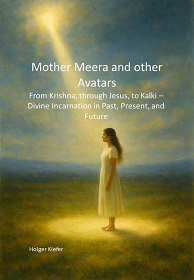
What role do avatars like Mother Meera play in today’s world? An intriguing question and illuminating answers in the book
- The “Descender” — A Voluntary Mission
Etymologically the word avatāra is rooted in Sanskrit: ava means “down” and tṝ stands for “crossing” or “traversing.” An avatar is therefore literally a “one who descends.” This term marks a decisive difference from Western or Gnostic myths: the divine presence on earth here is neither a fall from grace nor a painful exile or punishment. It is a deliberate, voluntary mission to preserve the cosmos.
The source text says:
“God descends — not in thunder, not in fire, not in law — but in a human body.”
This notion of a tangible God who takes on flesh unfolds an immense psychological power, especially in times of crisis. When transcendence enters the paradox of entering finitude, the divine becomes experientially accessible. It is the metaphysical promise that the Absolute is willing to share the burden of existence in order to restore order.
- The “Descender” — A Voluntary Mission
Etymologically the word avatāra is rooted in Sanskrit: ava means “down” and tṝ stands for “to cross” or “to traverse.” An avatar is thus literally a “one who descends.” This term marks a decisive difference from Western or Gnostic myths: the divine presence on earth here is neither a fall from grace nor a painful exile or a punishment. It is a deliberate, voluntary mission to preserve the cosmos.
The source text says:
“God descends — not in thunder, not in fire, not in law — but in a human body.”
This notion of a tangible God who takes on flesh unfolds an immense psychological power, especially in times of crisis. When transcendence enters the paradox of entering finitude, the divine becomes experientially accessible. It is the metaphysical promise that the Absolute is willing to share the burden of existence in order to restore order.
- The Cosmic Evolution of Forms
The doctrine of Vishnu’s ten avatars (Daśāvatāra), as unfolded in the Bhagavata Purana, is far more than an additive sequence of legends. It can be read as a theological interpretation of history that reflects increasing biological and social complexity. The first five forms mark the transition from the natural to the civilizational:
- Matsya (the Fish) — He saves primordial wisdom during a primeval flood; the preservation of spirit in times of total dissolution.
- Kurma (the Tortoise) — It stabilizes the world-mountain Mandara and serves as the foundation for the creation process.
- Varaha (the Boar) — He lifts the earth out of the waters of destruction and restores the material basis of life.
- Narasimha (the Man‑Lion) — He appears as a transcendent force that defies ordinary human logic to protect the devotee Prahlada when earthly laws and state authorities fail.
- Vamana (the Dwarf) — Through guile and apparent weakness he disempowers the arrogant king Bali — a victory of humility over the arrogance of power.
- The Bridge of Civilization: From Wilderness to Order
Between these early, hybrid forms and the philosophical depth of later avatars a decisive development takes place. Here we encounter Parashurama, the Brahmin with the axe, who exterminates a corrupt warrior caste — a symbol for the necessary purification when social structures have become unrecognizably corrupt.
He is followed by Rama, the hero of the Ramayana. Rama personifies Dharma as duty and social order. As the “perfect king” and human, he restores the moral ideal in the Treta‑Yuga, an age in which righteousness is already beginning to wane. Rama forms the essential bridge: with him the divine mission becomes fully a lesson in human ethics and statesmanship.
- Dharma Under Pressure — Why Avatars Appear
According to Indian cosmology, time is divided into four world ages (Yugas) in which morality steadily declines. An avatar appears whenever Dharma — the universal world-order — reaches a critical state of decay.
This is described as the rise of “Kali‑Yuga tendencies”: a moment of maximal entropy, marked by the loss of truth, the breakdown of social bonds, and the triumph of egoism. When the balance between creation and destruction threatens to tip, this condition compels a divine intervention. The avatar is thus the cosmic corrective factor that preserves the world from total moral collapse.
- Krishna — The God of a Thousand Paths
Among all manifestations, Krishna is the most multifaceted figure. He appears on the threshold of the dark Kali‑Yuga and acts no longer merely as the preserver of an external order but as a spiritual teacher in a torn age. In the Bhagavad Gita he reveals his universal form (Vishvarupa), in which the entire universe is contained at once — a bridge between the human and the absolutely transcendent.
Krishna teaches humanity three complementary paths to liberation
- Karma Yoga — the path of selfless action amid the world.
- Jnana Yoga — the path of intellectual and intuitive knowledge.
- Bhakti Yoga — the path of loving devotion. In it the playful, the strategic, and the transcendent unite into a single whole that points beyond mere dogma.
- The Avatar as Internal Reformer (The Buddha Effect)
A highly interesting phenomenon in the history of religions is the integration of the Buddha as the ninth avatar of Vishnu. From the perspective of comparative religion this is an act of theological inclusivism: a strategy by which one tradition absorbs its rivals in order to reform itself from within.
According to the Puranas, the Buddha appeared to mitigate the excessive and violent sacrificial rites of his time through the teaching of ahimsa (non‑injury) and compassion. Here the avatar functions as an internal reformer who breaks open a calcified ritual religion and returns it to an ethical core.
- Kalki — A Look into the Future
The sequence of avatars is an open narrative. At the end of the present, degenerate age Kalki is expected. While his predecessors often preserved or healed what existed, Kalki’s task is more radical. He will violently shatter the decayed order. This destruction, however, is not nihilism but the necessary tabula rasa for a complete new beginning — the certainty that after every phase of darkness a new light follows.
An eternal cycle of renewal
At its core the story of the avatar is a metaphysics of hope. It conveys the assurance that the universe is not subject to blind chaos, but that balance — however deeply disturbed — will be restored again and again.
In view of today’s “Kali‑Yuga tendencies” — a world of disinformation, social decay, and global instability — the old narrative gains new urgency. It challenges us to reflect: in what form would a “one who descends” have to appear in our highly complex modern world to restore the lost balance between humanity, nature, and spirit?
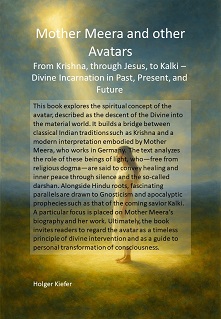
From Krishna, through Jesus, to Kalki – Divine Incarnation in Past, Present, and Future
Schreibe einen Kommentar