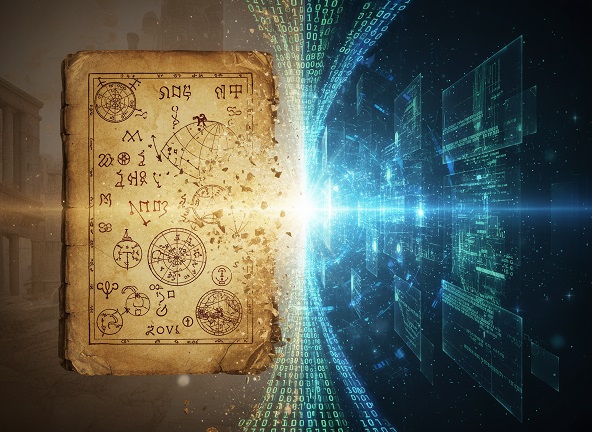
From ancient Gnostics to modern consciousness researchers, humanity has long wrestled with the same question:
what invisible forces shape our perception of reality?
The term Archon, derived from Greek for “ruler” or “authority,” appears in early Gnostic writings to describe powers that administer the material universe but obscure the higher, divine source.
For two thousand years, philosophers, mystics, and modern scholars alike have revisited this idea – seeing in the Archons either metaphysical beings, psychological archetypes, or metaphors for systemic control.
Below is a concise lineage of those who have shaped our understanding of the Archons and the nature of Gnosis – from Alexandria to Artificial Intelligence.
1 – The Ancient Gnostics and Early Philosophers
Valentinus (2 nd century CE)
One of the best‑known Gnostic teachers, Valentinus described the cosmos as emanating from a unified source (Pleroma).
His writings – including the Gospel of Truth and Gospel of Philip – portray the Archons as planetary rulers who hinder the soul’s return to the divine light.
Basilides and Simon Magus
Both articulated early systems where a secondary creator‑god (Demiurge) shaped matter apart from the ultimate God.
Their cosmology introduced the idea of a spiritual hierarchy filled with intermediary powers – prototypes of the Archons.
Plotinus (204 – 270 CE)
A Neoplatonic philosopher who criticized Gnostics yet shared their conviction that reality flows from a single source (the One).
Plotinus reframed evil as a privation of being – a notion strikingly close to the Gnostic concept of the Archons as entities of ignorance rather than true substance.
Church Fathers – Irenaeus, Tertullian and Hippolytus
Their polemical writings (Adversus Haereses) preserve much of what we know about early Gnostic cosmology.
While condemning Archonic teachings as heresy, they inadvertently ensured that Gnosis survived within Christian discourse.
2 – Modern Scholars and Mystics of the 20 th Century
Carl Gustav Jung (1875 – 1961)
The Swiss psychiatrist rediscovered Gnostic symbolism as a powerful map of the psyche.
Jung interpreted the Archons as archetypal complexes – autonomous forces within the collective unconscious that can possess human thought.
His mystical work Seven Sermons to the Dead explicitly blends Gnostic language with depth psychology.
Hans Jonas (1903 – 1993)
A philosopher and student of Heidegger, Jonas produced one of the foundational academic studies of ancient Gnosticism, The Gnostic Religion.
He regarded Gnosis as an existential response to alienation – a worldview eerily prophetic of the modern sense of disconnection from nature and spirit.
Gilles Quispel (1916 – 2006)
Dutch scholar and co‑editor of the Nag Hammadi Library.
He rescued Valentinian texts from obscurity and emphasized their experiential side – Gnosis as direct awareness, not dogma.
Rudolf Steiner (1861 – 1925)
Founder of Anthroposophy, Steiner reinterpreted the Archons as “Ahrimanic forces” – cold, calculating intelligences that harden consciousness and deny spirit.
His vision overlaps strongly with William Henry’s modern warning about AI as an Ahrimanic or Archontic technology.
Eugen Drewermann and Teilhard de Chardin (linking theology and evolution)
Both offered Christian reinterpretations of Gnostic insight: Drewermann through depth psychology, de Chardin through a mystical reading of evolution toward the Omega Point – the unitive consciousness of Christ.
3 - Contemporary Voices and Re‑Envisioning the Archons
John Lamb Lash
Author of Not in His Image – Gnostic Vision, Sacred Ecology, and the Future of Belief.
He reframes the Archons as inorganic intelligences intruding on human perception, and retells the myth of Sophia–Gaia as a planetary consciousness defending itself from their intrusion.
William Henry
In his presentation “How the Archons Built the Algorithm to Imitate the Soul,” Henry connects mythology to transhumanism.
For him, the Archons engineer high‑tech imitations of spirit, urging humanity to seek digital rather than spiritual transformation.
David Icke
While controversial, Icke popularized the Archon idea as a metaphor for political and psychological control systems – a populist echo of the same ancient fear of manipulation through illusion.
April DeConick (Rice University)
One of today’s most respected scholars of early Christian mysticism.
DeConick treats Archons not as demons but as cosmic caretakers in Gnostic thought – a nuanced reading that reveals how Gnosis reimagined divine hierarchy as interior consciousness.
Modern Consciousness Writers
On platforms such as zenitheye.net, thalira.com, and oreateai.com, spiritual thinkers explore how Archons symbolize algorithmic power, social conditioning, or psychic parasitism within collective consciousness.
4 – From Ancient Myth to Modern Metaphor
Across centuries, the Archons embody one recurring idea: forces of imitation that separate consciousness from its living source.
Where ancient teachers saw planetary rulers, modern researchers perceive societal structures, algorithms, or psychological fixations.
This continuity proves how adaptable – and how relevant – Gnostic insight remains.
Each era re‑invents the myth to confront its own version of enslavement:
- In late antiquity: fate and celestial determinism.
- In the industrial age: dogma and hierarchy.
- In our digital century: information overload and artificial imitation.
5 – Connection to Gnosis, Archons, and the Order Behind the World
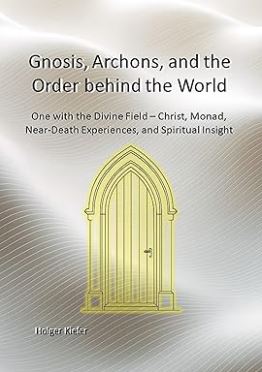
In my book Gnosis, Archons, and the Order Behind the World: One with the Divine Field, these historical insights merge into a coherent vision:
the Archons are not monsters to fight, but patterns of dis‑alignment within consciousness.
Healing begins where recognition replaces resistance.
The Divine Field is the hidden rhythm all these thinkers sought – the living coherence behind every myth, religion, and neuron.
Whether Jungian archetype or Henry’s AI‑Archon, the challenge is the same:
to remember that the real Light does not imitate – it emanates.
Key Sources and Further Reading
- The Nag Hammadi Library – in English edited by James M. Robinson
- Hans Jonas, The Gnostic Religion
- Carl G. Jung, Seven Sermons to the Dead
- John Lamb Lash, Not in His Image
- William Henry, The Skinularity is Near
- Holger Kiefer, Gnosis, Archons, and the Order Behind the World – One with the Divine Field
Schreibe einen Kommentar