
In our super-digital world, the word “avatar” pops up pretty much all the time. It’s our little picture on social media, our game character in virtual worlds, or a made-up identity online. But behind that modern mask lies one of the deepest and oldest stories humans tell. If you dig into the word’s roots and its theological side, you find a spiritual take on history that still feels surprisingly relevant. “God comes down — not in thunder, not in fire, not in law — but in a human body. That’s how one of the oldest and at the same time newest spiritual stories starts: the story of the avatar.”
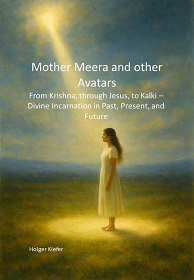
A book that makes you want to read it now
A quiet, powerful presence arrives on the page — and you can’t put the book down. This is not a dry study; it’s an invitation to witness a living mystery: Mother Meera as a modern avatar whose life and work bridge ancient wisdom and everyday reality. The writing pulls you in, scene by scene, until you feel the urge to turn the next page.
The “one who comes down” — mission, not exile
The word comes from Sanskrit: Avatāra is made of ava (“down”) and tṝ (“to cross” or “to pass through”). So literally, an avatar is a “one who comes down.” In Hindu tradition, especially around Vishnu, the preserver of the cosmos, the term means a lot more than just moving from above to below. An avatar isn’t a fallen angel or a god punished by being dumped into matter. It’s a voluntary mission. When an avatar shows up, it’s a deliberate divine intervention in the human world. They appear whenever the universal balance — dharma — is collapsing. Think of them as a divine corrective that restores the balance between creation and destruction, truth and falsehood.
A cosmic evolution: from instinct to civilization
The story of Vishnu’s ten avatars, the Daśāvatāra, as told in the Bhagavata Purana, reads like a symbolic evolution. It starts with basic life forms and climbs up to complex human morality. In the early world-ages (yugas), the divine first shows up in animal forms to secure the basics of existence:
- As Matsya (the fish), Vishnu saves ancient wisdom and the seed of life from a world-swallowing flood — a symbol for keeping the spiritual core safe during times of mental deluge.
- As Kurma (the turtle), he steadies the world-mountain Mandara in the ocean of milk, giving the foundation needed for creation.
- As Varaha (the boar), he lifts the earth out of the waters of dissolution, reclaiming the material and moral ground for life. As the world gets more complex, the way the divine intervenes changes. When human laws and authorities fail, the divine can burst in as an unpredictable force: that’s Narasimha, the man-lion, who showed up to protect his devotee Prahlada and smash the limits of human logic. The move toward human civilization is marked by Vamana, the dwarf, who dethroned the arrogant king Bali not by brute force but by cleverness and humility — an early win for wise self-restraint over power’s arrogance. But when social structures are totally corrupt, dharma calls for harsher measures. That’s Parashurama — the “Brahmin with an axe,” a paradoxical image of a priest taking up arms to wipe out a corrupt warrior caste and clear the way for ethical renewal.
Rama and Krishna: perfecting the human
In later ages the avatars get more human and their stories more socially complex. Here we meet two of the most famous figures of Indian epic tradition, whose actions show the slow moral decay across world cycles. Rama, hero of the Ramayana, appears in the Treta Yuga, when righteousness is already cracking. He’s the ideal human — the perfect king, son, and husband. His fight against the demon Ravana is a lesson in unwavering duty (dharma), kept even through great personal suffering. On the edge of the dark age, in the Dvapara Yuga, Krishna appears. He’s way more layered, almost transcendent. As a divine guide he leads Arjuna through a brutal civil war and lays out, in the Bhagavad Gita, teachings on duty, devotion, and especially non-attachment. Krishna also reveals his Vishvarupa — a dizzying universal form that contains all creation. In a torn world he offers people different paths to freedom: the path of selfless action (Karma Yoga), knowledge (Jnana Yoga), and loving devotion (Bhakti Yoga).
The avatar as inner reformer and radical new start
The avatar story isn’t stuck in the past. It includes change and looks forward:
- The Buddha is often seen, in a notable theological reading, as an avatar who acted as an inner reformer. His mission was to soften the rigid ritual religion of his time and replace violent sacrificial rites with teachings of compassion and nonviolence (ahimsa).
- Kalki is the future avatar expected at the end of the current, degenerate Kali Yuga. When darkness is thickest, he’s meant to violently smash the old corrupt order. In the cyclical worldview, that destruction isn’t the end of the world but the necessary condition for a total, clean new beginning.
Takeaway: the wisdom of targeted intervention
Beyond techy uses of the word, the ancient avatar idea teaches us about renewal. The avatar stories show that progress isn’t a straight line — it needs impulses from “above” or “within” to keep values like justice, knowledge, and compassion from falling apart. An avatar is basically a symbol of hope: that order can beat chaos, and that crises — however dark — are often the prelude to a needed reset. If we take the idea of targeted intervention seriously, one big question remains: where in today’s world — or in your own life — is a “descent” of new clarity most urgently needed to restore a lost balance?
The avatara Mother Meera opened a new, fascinating chapter in human history. From India to Germany and beyond. Learn more in this book.
Why this book grabs you
- Immediate curiosity — It opens with a striking claim: the divine can descend into the human. That promise hooks readers who want more than theory.
- Human stories, not abstractions — Vivid episodes and personal encounters make spiritual transformation feel tangible and urgent.
- A map for our times — The book connects ancient avatar teachings to modern crises, showing why Mother Meera’s presence matters now.
What you’ll discover inside
Moments of encounter — Real-life meetings that change people’s inner landscape.- Practical clarity — How quiet, direct presence can bring peace, guidance, and insight without dogma.
- A living lineage — The thread from classical avatar stories to a contemporary figure who moves between India, Europe, and the wider world.
- Paths to inner renewal — Concrete ways readers can apply these teachings in daily life.
Who this book is for
Readers hungry for meaning, seekers tired of gimmicks, and anyone who’s ever wondered whether spiritual experience can be simple, immediate, and life-changing. It’s written to be read in one sitting or returned to like a trusted guide.
The pull you’ll feel
The prose doesn’t lecture — it opens a door. Once you step through, you’ll want to know more about the people whose lives shifted after meeting Mother Meera, the subtle practices she embodies, and the quiet logic behind an ancient idea made new. This book doesn’t just inform; it compels.